Journal — Physics
One cavity, three domains
A January 2026 design explored whether a shared description of boundaries could support acoustic, thermal, and airflow tools.
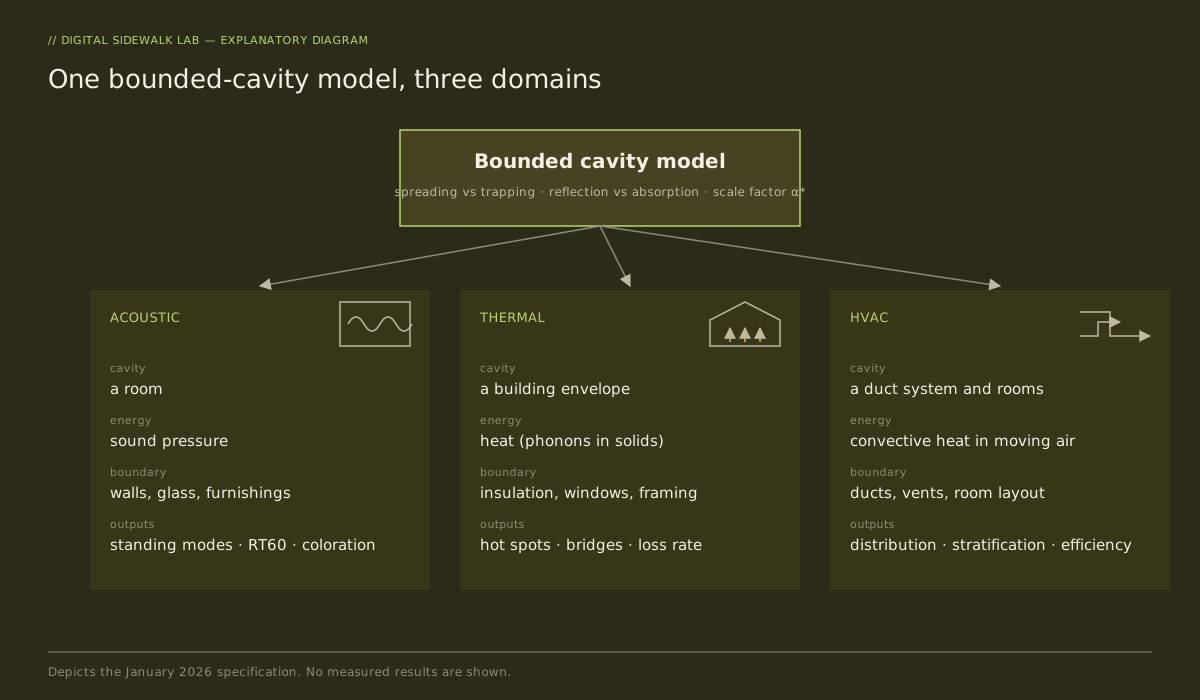
In January 2026 I wrote a specification called the Cavity Resonance Oracle. It explored a shared way to describe a bounded space across three applications: room sound, heat loss through a building envelope, and heating and cooling distribution.
The practical attraction was reuse. Each application requires a description of geometry, materials, boundaries, and the behavior of energy within a space. A common representation might reduce duplicated setup work and help compare different kinds of observations about the same building.
What the specification proposed
The acoustic application concerned room modes, reverberation, and the effect of a room on a voice. The building-envelope application concerned heat loss and locations needing closer inspection. The airflow application concerned distribution through ducts and rooms.
The proposed model used layered boundaries, a spacing parameter derived from the golden ratio, and a return-signal term called slapback. These were modeling choices in the specification. Their usefulness has not been established through an experimental evaluation.
A shared description of a building does not, by itself, establish that the same equations or calibration will work in all three applications. That correspondence is a question the model would need to answer before transferring a result between domains.
A concrete application: Home Leak Mapper
The same specification proposed an app that would turn thermal images into a prioritized inspection record, with location and building context attached. It also described how reduced-precision records could accumulate into a regional dataset. The app remained a proposal.
This gives the modeling work a practical test. Could the proposed method improve an inspection or prediction compared with an established approach using the same inputs? The original document includes candidate checks for room reverberation and agreement with building audits. A useful evaluation would define the test cases and comparison methods before running them.
The design belongs in the Lab's record because it identifies an application and a modeling question that can be revisited. It is also part of the history of treating place, physical observations, and source information together—the concerns now carried into the map work.