Journal — Method
From an observation to an explanation
Four record levels help the Lab track how a measurement becomes a signal, a pattern, or a hypothesis.
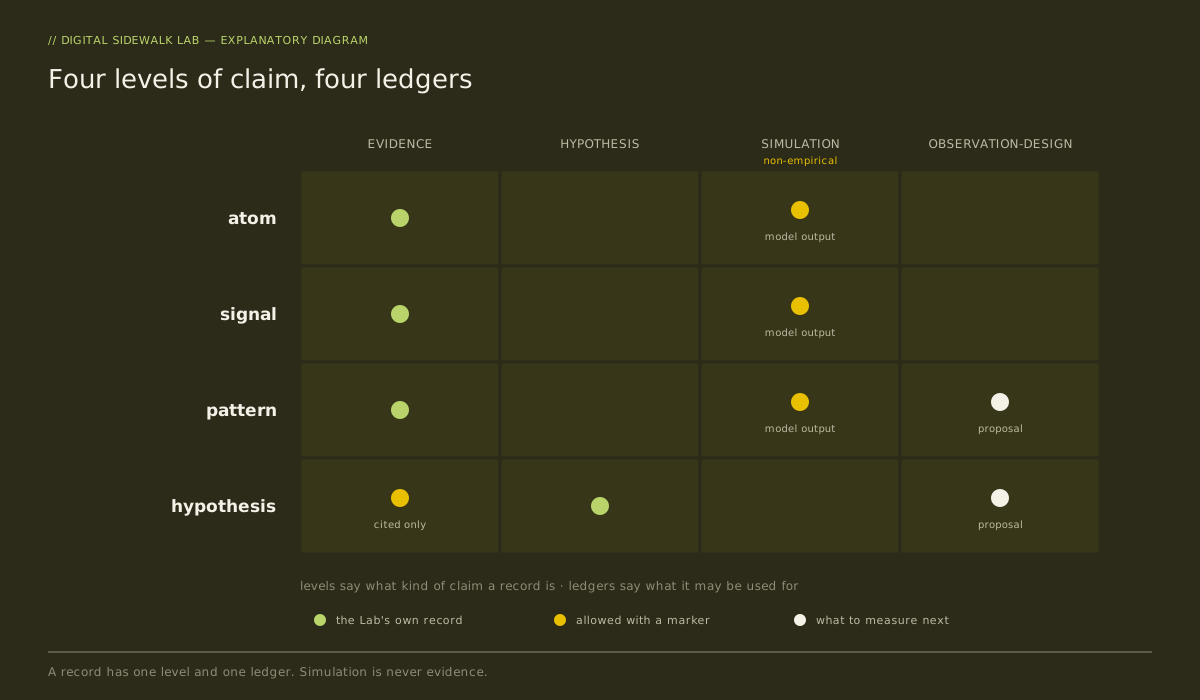
A reading, an unusual change, and an explanation for that change are different kinds of statements. In August 2026 I formalized a record structure to keep those distinctions visible across the Lab's research threads.
The structure uses four levels. An atom is an individual observation or derived value with its source and context. A signal is a departure from a stated baseline. A pattern is a relationship identified across records. A hypothesis is a proposed explanation that can be investigated.
Following a claim through the system
A phone reports a value at a particular time. That is an individual record. A detector may flag a departure from its baseline, producing a signal. Comparing several signals with other observations may suggest a pattern. A proposed reason for that pattern belongs in a hypothesis record.
Each step needs its own method and references. Keeping the source reading does not establish the explanation, and changing an interpretation should not require rewriting the source.
Separating measured and simulated work
The framework also uses separate ledgers for evidence, hypotheses, simulations, and observation design. The ledger describes the role of a record: an observed input, a proposed explanation, a model-generated output, or a recommendation about what to measure next.
For a cited claim, the record must distinguish evidence that someone published a statement from evidence that the statement is true. For a simulation, it must retain the assumptions that generated the output.
This structure is intended to support work across sources such as environmental sensing, audio observations, and place-based records. Its usefulness comes from making the route from input to claim inspectable.
That matters to both the map and radio vision. A map should show the basis for a displayed value. A host should be able to tell whether a statement comes from a direct observation, a forecast, or an interpretation. The record structure gives each of those uses a place to begin.