Journal — Method
Testing the framework in another community
The next research question is which observations from Buildspace remain useful across different settings.
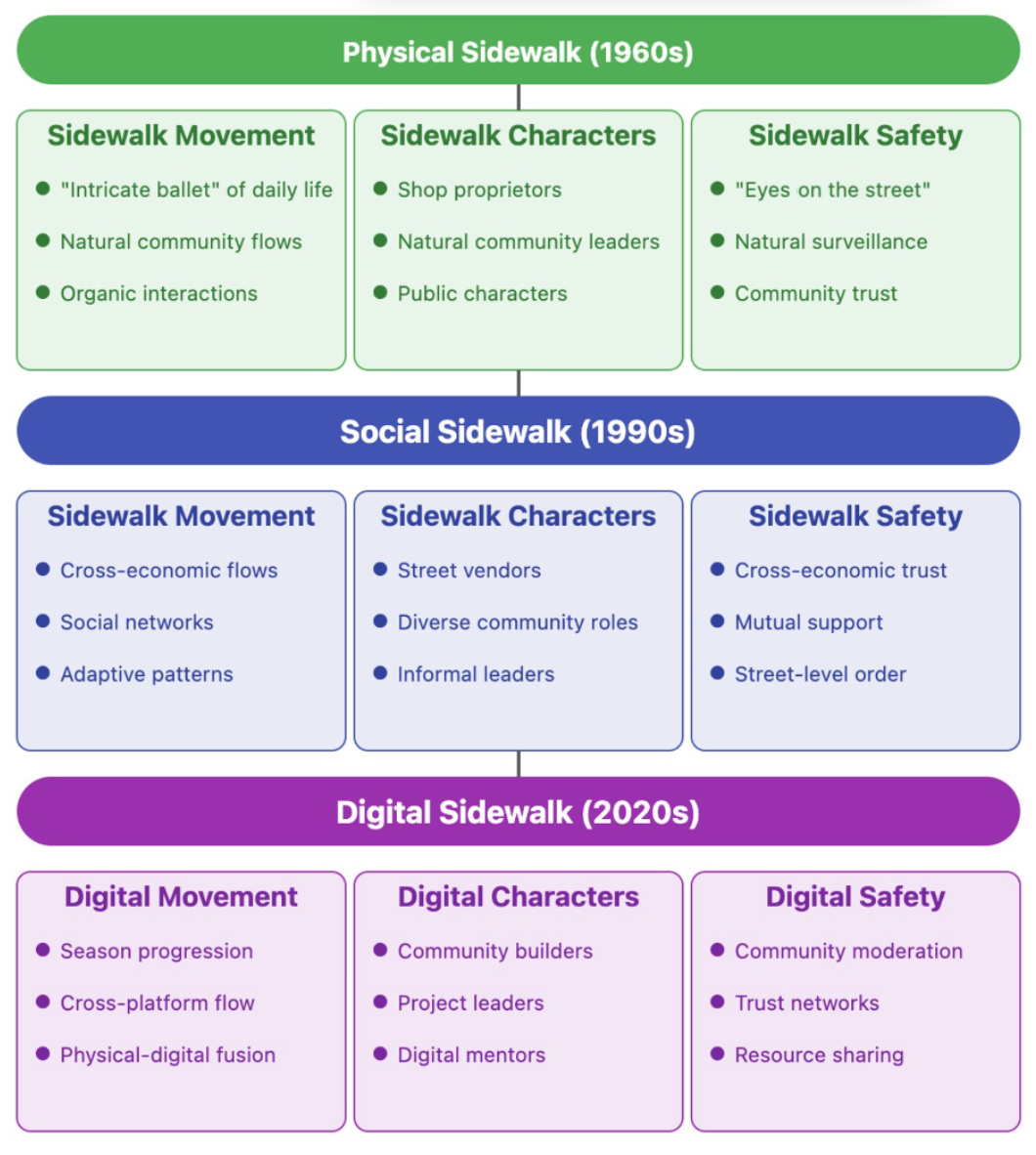
The Digital Sidewalk study examined one community. Extending the framework requires asking which parts help explain another setting and which depend on Buildspace's particular program, membership, or media.
The August 2026 global protocol sets out that research question. Its first useful step is a bounded comparison, rather than an attempt to assign every community a score.
What would be observed
The proposed observations include continuity of participation, recurring informal contact, connecting roles, different uses of a shared setting, routes between activities, and the handling of boundaries and problems. These give the movement, characters, and safety dimensions specific places to investigate.
Definitions would need to be usable across the selected settings. A behavior that looks similar on two platforms may serve different purposes, so counts alone would be insufficient. Field context and participants' accounts remain part of the method.
The protocol also separates information reaching someone from changes in what they understand or do. A reply, a return visit, and a durable change in practice are different observations.
What would challenge the framework
A comparison should state in advance what would count against the proposed interpretation. Perhaps the dimensions cannot be identified consistently. Perhaps a simpler explanation accounts for the observed learning. Perhaps a mechanism described in Buildspace is absent from the second community.
Simulation can help explore assumptions and plan an evaluation, but evidence about people requires observation of people. The protocol calls for comparison methods, documented interpretation, and external scrutiny.
The next step is to choose settings small enough to study closely and preserve the material needed to challenge the analysis. A useful result could narrow the framework as much as extend it. Either outcome would give the Lab a better account of when its method is useful.