Journal — Buildspace — journal entry
Making the framework explicit
The dissertation defense clarified how I should state the contribution and explain what can be observed.
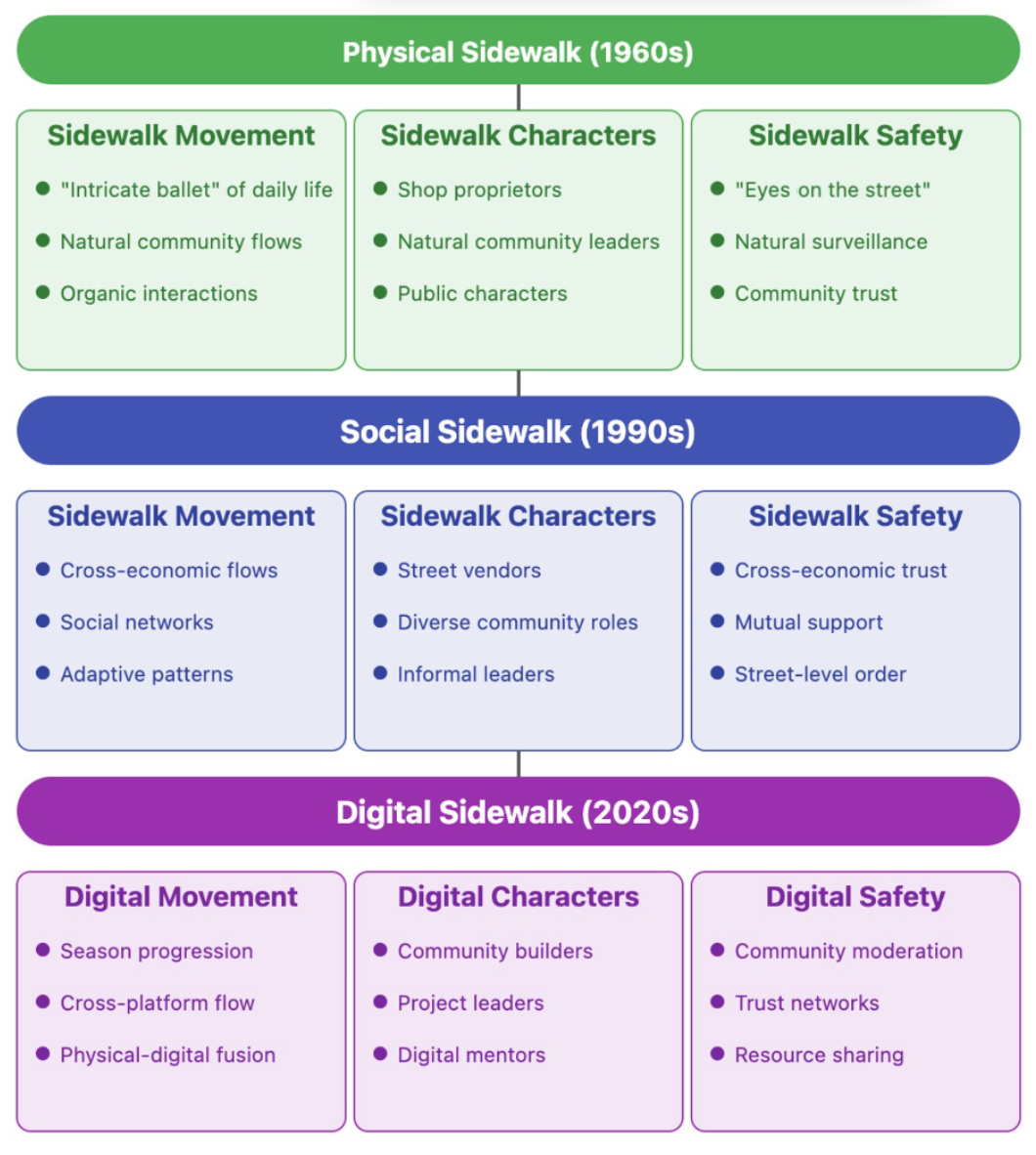
At my dissertation defense in March 2025, the committee asked me to make the contribution more explicit. The framework was already in the study. The revision was to state clearly, in the abstract, introduction, and conclusion, what the research introduced.
That required more than choosing a stronger adjective. I needed to explain what another researcher could do with the framework and what evidence would support an interpretation made through it.
Turning the dimensions into research questions
For movement, a researcher can trace how someone enters an activity, finds help, moves between settings, and returns. In Buildspace, that could mean following a question into a conversation and then into a project attempt.
For characters, the evidence lies in repeated behavior. Someone becomes recognizable as a guide or connector through what they do over time. Visibility alone is insufficient to establish the role.
For safety, the researcher examines the conditions around participation. What happens when someone shares unfinished work? How are questions received? How are difficulties handled? These questions direct attention to interactions and circumstances that an activity total would miss.
This is the sense in which I describe the framework as measurable: its dimensions can be investigated through documented observations. A numerical instrument would require further work to define and evaluate its measures.
Stating the contribution at the right scale
The dissertation's argument is that bringing these theoretical perspectives together provides a useful way to study learning in a community that crosses physical and digital settings. Its literature review is where that contribution is situated relative to prior research.
The defense sharpened the distinction between describing a community and offering a framework another researcher could use. The resulting dissertation and paper are the basis for the Lab's continuing work on community observation.
❤️💙💛💚