Journal — Open source
Opening the sensing platform
The planned release separates the collection and observation tools from optional detection engines.
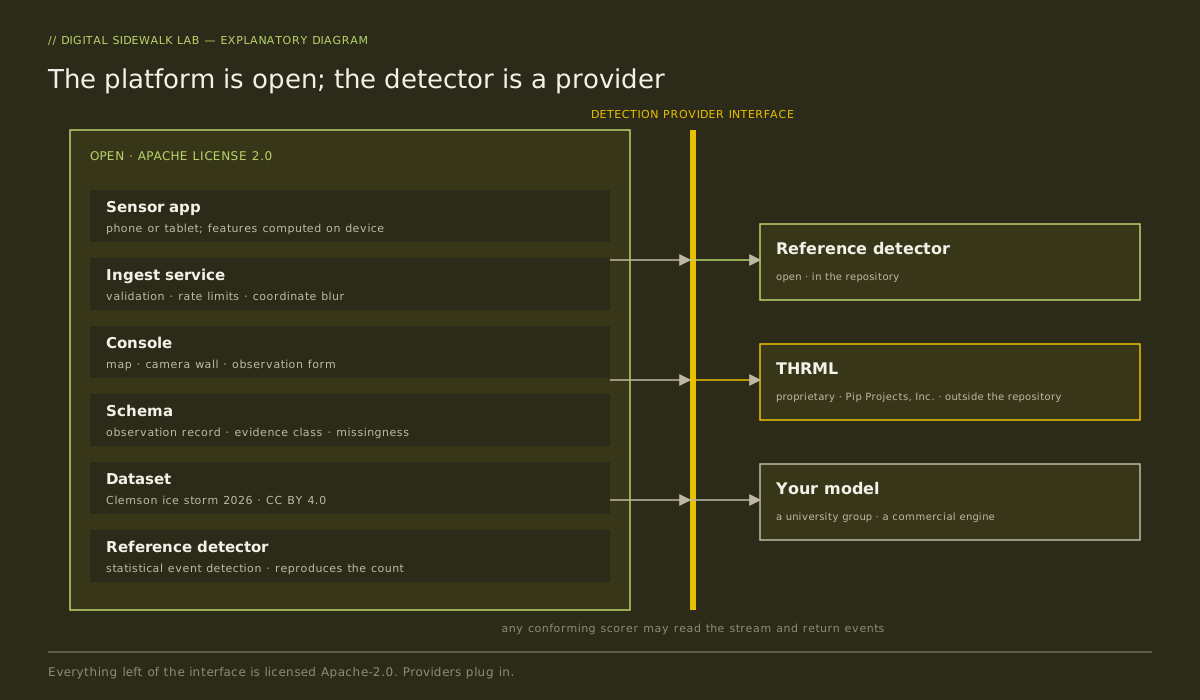
The sensing platform is being prepared for a public release that others can run without the Lab's private detection methods. The collection tools, record format, and reference analysis form the shared foundation. Additional detection engines can connect through a defined interface.
The September 2026 project record describes a prepared package. A public repository and downloadable dataset are not linked in this edition of the journal.
What the package is intended to provide
The package includes a device-side feature collector, an ingest service, the observation schema, a console, sample field data, and a reference detector. The reference detector is intended to make an event-counting procedure inspectable and repeatable. Its output still needs to be checked against the reported storm analysis before the release presents that count as reproduced.
The planned licensing separates the artifacts: Apache 2.0 for the platform and reference-detector code, and CC BY 4.0 for the dataset. The license files accompanying the release will define their terms.
Where detection engines connect
The Detection Provider Interface specifies how a detector receives observations and returns proposed events. That boundary lets a contributor investigate a different scoring method without replacing the entire collection platform.
The Lab's own detection work is intended to use the same boundary. It is separate from the public package and should not be required to install the platform, inspect the sample data, or run the reference workflow.
The first contributions
The immediate milestone is a documented outside installation and analysis run. That should establish what works without private setup knowledge and identify failures before a broader field season.
After release, contributors could help by operating a documented node, improving source and device handling, or comparing detectors on shared inputs. The most useful field contribution would include enough context to interpret the readings: device, placement, interruptions, calibration status, and observation times.
The planned multi-station season would extend the current single-site record. It would also provide the practical basis for further open-source development and funding proposals, without making either dependent on claims the field data has not yet established.