Journal — Method
Comparing recordings from different phones
A proposed calibration protocol asks how much device variation can be estimated without a reference microphone at every node.
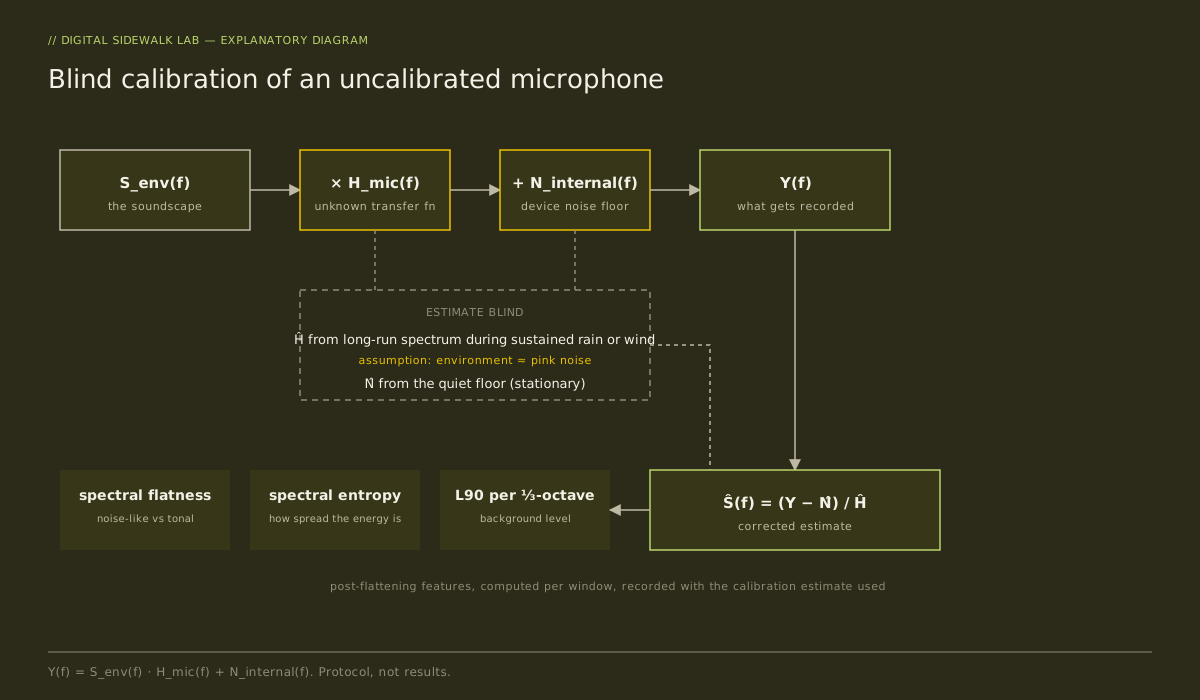
A volunteer sensing network will use different phones in different conditions. Before comparing their recordings, the Lab needs to understand how much of an apparent difference comes from the devices themselves.
The August 2026 calibration proposal addresses that problem. It asks whether a useful estimate of a device's frequency response can be recovered from environmental recordings, reducing the need for a reference microphone at every operating node.
The proposed approach
The protocol models a recording as environmental sound shaped by a device response, with additional noise. It proposes using sustained environmental conditions to estimate the response and quieter intervals to investigate the noise contribution.
One candidate assumption is that selected rain or wind intervals have a sufficiently predictable spectral shape to serve as a reference. That assumption needs to be tested. The surrounding surfaces, placement, weather, and device processing can all affect what is recorded; a quiet interval also contains environmental sound and cannot simply be treated as the device's internal noise.
The objective is therefore an evaluated correction, with an uncertainty estimate and a documented range of use. A correction formula alone does not establish that recordings have become comparable.
How I would evaluate it
Record the same conditions with phones and a calibrated reference instrument placed together. Estimate the correction without using the reference result, then compare corrected and uncorrected recordings against it. Repeat across devices and conditions that were not used to develop the procedure.
The evaluation should ask which features improve, which become worse, and when the method should decline to apply a correction. Existing recorder-equalization research provides a comparison point; estimating a response without a reference is a proposal to assess, not a novelty claim established by this article.
Keeping calibration visible
A map user needs to know whether a value is uncorrected, corrected through an estimate, or measured against a reference. The observation record should carry that status, the method version, and the limitations of the correction.
The protocol is written and awaits field evaluation. Its role in the next sensing season is to test whether the proposed correction improves comparisons between devices.